PMI costs $30–$70 per month per $100,000 borrowed. Here's how to cancel it early and turn that payment into years of mortgage freedom.
Key Takeaways
- You can request PMI cancellation once your balance reaches 80% of the home's original value, and your servicer must comply if you are current on payments and have no second lien.
- Your servicer must cancel PMI automatically at 78% of original value — but waiting for that date instead of requesting at 80% typically costs an extra $2,400 to $4,800 in premiums.
- If your home has appreciated, Fannie Mae lets you cancel at 75% LTV of current value between years two and five, or 80% of current value after year five.
- Lender-paid PMI (LPMI) can never be cancelled — it is priced into your interest rate, so refinancing is the only exit.
- Redirecting a canceled $200 PMI payment into principal on a $320,000 loan at 6.5% pays the mortgage off 6 years 7 months early and saves $105,429 in interest.
Private mortgage insurance (PMI) is one of the few mortgage costs you can legally eliminate without refinancing — yet millions of homeowners keep paying it for years longer than they have to. If you put less than 20% down, you are probably paying $30 to $70 per month for every $100,000 you borrowed, and that money protects your lender, not you. This guide shows you exactly when you can cancel PMI, how to speed up the date, and how to turn the freed-up payment into a much faster mortgage payoff.
What Is PMI and Why Are You Paying It?
PMI is insurance your lender requires when your down payment is under 20% of the home's value. It reimburses the lender if you default — you get no direct benefit from it. Premiums typically run 0.46% to 1.5% of your loan amount per year depending on your credit score and down payment, added straight to your monthly bill.
Here is the math on our standard example: a $320,000 loan at 6.5% for 30 years has a principal-and-interest payment of about $2,023 per month. At a typical PMI rate of 0.75%, you pay an extra $200 per month ($320,000 × 0.0075 ÷ 12). That is $2,400 a year buying you nothing once you have real equity — which is exactly why removing it early is one of the highest-return moves in any mortgage payoff strategy.
How Do You Remove PMI Early? The 80% and 78% Rules Explained
The federal Homeowners Protection Act gives you three removal paths on conventional loans:
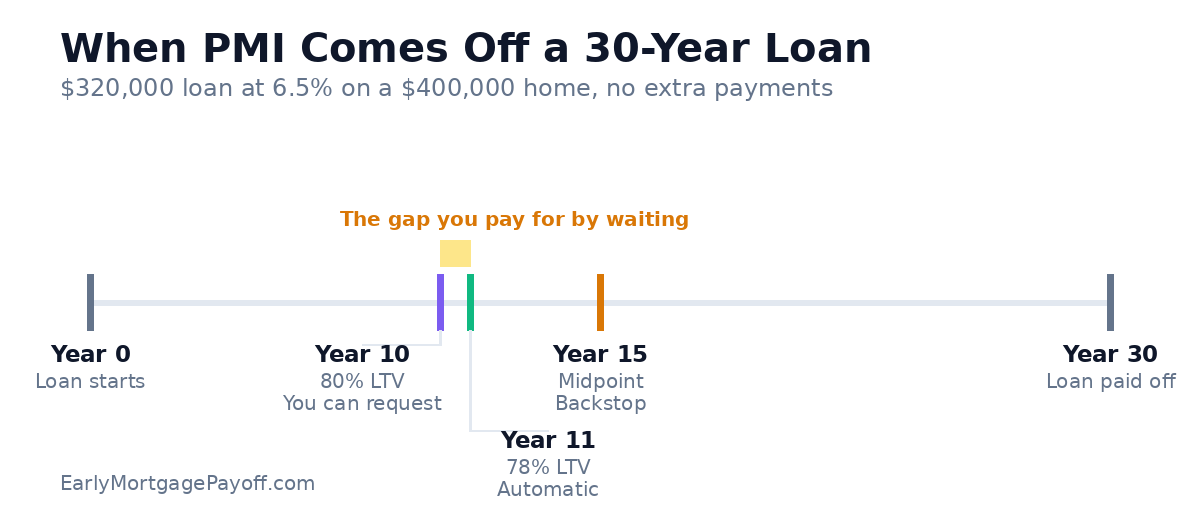
- Borrower-requested cancellation at 80% LTV. When your balance reaches 80% of the home's original value (purchase price or original appraisal, whichever is lower), you can request cancellation in writing. You must be current on payments, have a good payment history, and have no second lien on the home. The lender may require proof the value hasn't dropped.
- Automatic termination at 78% LTV. Even if you never ask, the lender must cancel PMI when your balance is scheduled to hit 78% of original value, as long as you are current.
- Midpoint termination. If neither threshold is reached earlier, PMI must end at the halfway point of your loan term (year 15 of a 30-year loan) if you are current.
There are two accelerators most homeowners miss. First, extra principal payments count — the 80% trigger is based on your actual balance, so prepaying moves the date up. Second, rising home values can qualify you early: many servicers will cancel PMI based on a new appraisal showing 75–80% LTV of current value (rules vary; most require 2–5 years of seasoning). One important exception: FHA loans are governed by different rules. Under HUD Mortgagee Letter 2013-04, for case numbers assigned on or after June 3, 2013, a loan with an LTV above 90% at origination carries mortgage insurance (MIP) for the full loan term; at 90% LTV or below, MIP ends after 11 years. Either way the only early exit is refinancing into a conventional loan once you have 20% equity.
PMI vs. FHA MIP vs. LPMI vs. VA Funding Fee: Which Can You Cancel?
Only borrower-paid PMI on a conventional loan can be cancelled on request — the other three either never cancel, cancel on a fixed schedule you cannot accelerate, or were paid once at closing. Knowing which one you have determines whether the rest of this guide applies to you or whether refinancing is your only exit.
| Insurance type | Who it protects | Can it be cancelled? | How to get rid of it |
|---|---|---|---|
| Borrower-paid PMI (conventional, under 20% down) |
The lender | Yes — on request at 80% LTV; automatic at 78% | Written request to your servicer, or reach 78% and wait. Extra principal payments move both dates closer. |
| FHA MIP (case number on/after June 3, 2013) |
The FHA insurance fund | Usually no — if LTV was above 90% at origination, MIP lasts the full loan term | Refinance into a conventional loan once you hold 20% equity. If original LTV was 90% or less, MIP ends after 11 years. |
| Lender-paid PMI (LPMI) | The lender | No — it is priced into your interest rate, so there is nothing to cancel | Refinance. The Homeowners Protection Act cancellation rights do not apply to LPMI. |
| VA funding fee | The VA loan program | Not applicable — a one-time fee, not ongoing insurance | Nothing to cancel. VA loans carry no monthly mortgage insurance at all. |
According to U.S. Mortgage Insurers, private MI helped more than 800,000 borrowers finance a home in 2025, and nearly 65% of them were first-time buyers — so borrower-paid PMI is by far the most common of the four, and the one most likely to be cancellable.
How Much Can You Actually Save?
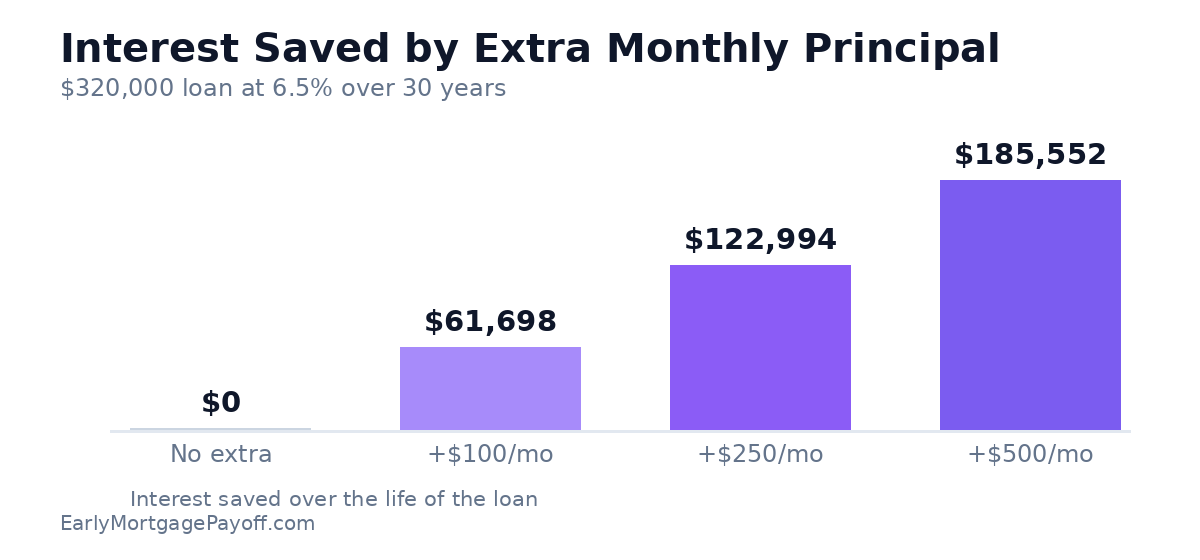
Removing PMI saves you $200 a month in our example — but the real win comes from redirecting that money into principal. Here is what extra monthly principal does to the $320,000 loan at 6.5%, which would otherwise cost $408,142 in total interest over 30 years:
| Loan details | Monthly payment | Total interest | Payoff date | You save |
|---|---|---|---|---|
| Standard — $320,000 at 6.5%, 30 yr | $2,023 | $408,142 | Aug 2056 | — |
| +$100/month extra principal | $2,123 | $346,444 | Oct 2052 | $61,698 and 3 yrs 10 mo |
| +$250/month extra principal | $2,273 | $285,148 | Nov 2048 | $122,994 and 7 yrs 9 mo |
| +$500/month extra principal | $2,523 | $222,590 | Aug 2044 | $185,552 and 12 yrs 0 mo |
Notice the sweet spot: simply redirecting a canceled $200 PMI payment into principal — money you were already spending — pays the loan off 6 years and 7 months early and saves about $105,429 in interest. You can run your own loan's numbers in seconds with our extra payment calculator, which also shows the exact month your PMI drops off.
PMI Removal Date Calculator: When Does Your PMI Drop Off?
Enter your loan details below to see the exact month your balance reaches 80% of the original value (when you can request cancellation) and 78% (when your servicer must cancel automatically). Everything is calculated in your browser — nothing is sent to our servers.
What Is Lender-Paid PMI (LPMI) and Why Can't You Cancel It?
Lender-paid PMI cannot be cancelled because you never pay it as a separate line item — your lender bought the policy up front and recovered the cost by charging you a permanently higher interest rate. There is no monthly premium to remove, so reaching 80% or 78% LTV changes nothing.
This is the most misunderstood item on a mortgage statement. Homeowners with LPMI often reach 20% equity, call their servicer to cancel, and are told there is nothing to cancel. The federal Homeowners Protection Act, which creates the 80% request right and the 78% automatic termination right, applies only to borrower-paid mortgage insurance.
LPMI usually carries a rate roughly 0.25% to 0.50% higher than the same loan with borrower-paid PMI. That trade is genuinely cheaper in the early years, which is why it gets sold. The problem is the back half of the loan: borrower-paid PMI disappears around year 8 to 12 on a typical purchase, while the LPMI rate premium runs for the entire 30 years. On a $320,000 loan at 6.5%, a rate just 0.25% higher costs about $19,000 in extra interest over the full term.
Your only exit is refinancing into a conventional loan with no mortgage insurance, which requires 20% equity and only makes sense if current rates are at or below your existing rate after closing costs. Run the numbers with our refinance vs. payoff calculator first — for many LPMI borrowers with a low locked-in rate, staying put and prepaying principal beats refinancing.
How do you know which type you have? Check your closing disclosure. Borrower-paid PMI appears as a monthly line item; LPMI appears nowhere on your monthly statement, but your loan estimate will note "lender-paid mortgage insurance" and your rate will be higher than the par rate you were quoted.
How Long Does PMI Removal Actually Take?
Most PMI cancellations take 30 to 60 days from written request to the first premium-free payment, though it can stretch longer if your servicer orders a full appraisal. The clock does not start until your servicer receives the request in the format they require, which is why calling first matters.
- Written request received — day 0. Some servicers accept a verbal request, but a written one creates the paper trail you will want if the process stalls.
- Eligibility verification — days 1 to 15. The servicer confirms your LTV, that you are current, and that there is no second lien on the property.
- Valuation, if required — days 10 to 45. A broker price opinion takes about a week; a full appraisal can take three to four weeks in a busy market. You typically pay this cost, generally $100 to $600.
- Decision and effective date — days 30 to 60. If approved, PMI stops on a specific payment date. Confirm in writing which payment is the first without the premium, and check that statement carefully.
Two seasoning rules govern cancellation based on your home's current value rather than its original value. Per the Fannie Mae Servicing Guide (B-8.1-04), for a one-unit principal residence you need an LTV of 75% or less if the loan is between two and five years old, or 80% or less once the loan is more than five years old. Fannie Mae also defines an acceptable payment record precisely: current at the time of the request, no payment 30 or more days late in the past 12 months, and no payment 60 or more days late in the past 24 months.
What if your servicer stalls? Put the request in writing and reference the Homeowners Protection Act by name. If you get no substantive response within 60 days, or the servicer refuses without citing a specific eligibility failure, file a complaint with the Consumer Financial Protection Bureau. Servicers must respond to CFPB complaints, and in practice a filed complaint resolves stalled cancellations faster than repeated phone calls.
The PMI Cancellation Request Letter (Free Template)
A written request is what starts the clock. Servicers are not required to act on a phone call, and a written letter citing the Homeowners Protection Act by name creates the paper trail you will need if the request stalls. Here is the opening of the letter — the part that does the legal work:
RE: Request to cancel private mortgage insurance
Loan number: [YOUR LOAN NUMBER]To whom it may concern:
I am writing to request cancellation of the private mortgage insurance on the loan referenced above, under the Homeowners Protection Act of 1998 (12 U.S.C. 4901 et seq.).
The original value of the property was [ORIGINAL VALUE], and the current principal balance is [CURRENT BALANCE] as of [STATEMENT DATE]. This places the loan-to-value ratio at [LTV]%, at or below the 80% threshold at which a borrower may request cancellation.
I confirm that I am current on all payments, that I have no payment 30 or more days past due within the last 12 months and none 60 or more days past due within the last 24 months, and that there is no subordinate lien on the property.
Three details in those paragraphs are what make a servicer act rather than stall: citing the statute by name, stating the loan-to-value ratio against the original value, and pre-confirming the payment-history conditions so there is nothing left to ask you for. The rest of the letter asks for the one thing homeowners most often forget to request — written confirmation of exactly which monthly payment will be the first without the premium.
The free kit below includes the complete letter, plus three things that letter alone will not solve:
- A pre-send checklist covering the eligibility items that cause most denials — second liens, FHA versus conventional, borrower-paid versus lender-paid PMI, and the payment-history rules.
- An escalation letter for a servicer that goes quiet, requesting a written decision within 15 days and naming the CFPB complaint route.
- A one-page timeline of what happens between sending the letter and the premium disappearing, so you know when a delay is normal and when to push.
Step-by-Step: How to Cancel PMI and Redirect the Savings
- Find your PMI cost and current LTV. Check your mortgage statement or annual escrow analysis for the exact PMI premium. Divide your current balance by your home's original value — if you're at or near 80%, you can act now.
- Pull your full amortization schedule. Use our amortization calculator to see the exact month your balance crosses 80% and 78% of original value. Mark both dates — the gap between them is money.
- Prepay principal to reach 80% faster. Even temporary extra payments make sense here, because every dollar of principal both earns 6.5% and moves your PMI cancellation date closer. A lump sum from a bonus or tax refund works too.
- Request cancellation in writing. Call your servicer for their PMI removal process, then follow up with a written request. Expect them to verify you're current, check for second liens, and possibly order a broker price opinion or appraisal ($100–$600, usually paid by you).
- If your home has appreciated, ask about a value-based cancellation. If local prices have risen since you bought, a new appraisal showing 75–80% LTV of current value may qualify you years ahead of schedule.
- Redirect the freed payment to principal immediately. The day PMI drops off, set up an automatic extra principal payment for the same amount. Your total monthly outlay stays identical, but the loan now shrinks dramatically faster. Pairing this with biweekly payments compounds the effect further.
Common Mistakes Homeowners Make with PMI Removal
- Waiting for automatic termination at 78%. The gap between 80% (when you can request) and 78% (when it's automatic) is typically 1–2 years of premiums — roughly $2,400 to $4,800 in our example — thrown away for the price of one phone call and a letter.
- Assuming PMI removal rules apply to FHA loans. FHA mortgage insurance follows different rules, and for most post-2013 loans it never cancels. If you have an FHA loan with 20%+ equity, compare a conventional refinance instead — our refinance vs. payoff calculator shows whether the closing costs are worth it.
- Not confirming extra payments are applied to principal. Some servicers apply unmarked extra money to the next month's payment or to escrow. Always mark payments "apply to principal" and verify on the next statement — otherwise your 80% date never moves.
- Absorbing the canceled PMI into spending. The most expensive mistake is invisible: cancel PMI, feel richer, and spend the $200. Homeowners who automate the redirect on day one are the ones who actually capture the six-figure savings.
Is Removing PMI Early Right for You? Key Questions to Ask
Is your loan-to-value ratio at or near 80%? If yes, request cancellation now — there is virtually no downside. If you're within a year of the threshold, modest prepayments can close the gap quickly.
Has your home's value risen significantly since purchase? If yes, a $100–$600 appraisal that eliminates $2,400+ per year in PMI is one of the best returns available anywhere.
Do you have high-interest debt or no emergency fund? If yes, still cancel PMI as soon as you qualify — but send the freed-up cash to credit cards or savings first. Extra mortgage principal comes after those bases are covered.
Is your loan FHA rather than conventional? If yes, run the refinance math before anything else. The PMI-removal playbook above only works on conventional loans.
Frequently Asked Questions
How do I know if I'm paying PMI?
Check your monthly mortgage statement for a line item labeled PMI, MI, or mortgage insurance premium. Your annual escrow analysis also lists it. If you put down less than 20% on a conventional loan and haven't reached 78% LTV, you are almost certainly paying it.
Does PMI automatically go away?
On conventional loans, yes — federal law requires termination when your balance is scheduled to reach 78% of the home's original value, or at the loan's midpoint, as long as you're current on payments. But waiting for the automatic date instead of requesting removal at 80% typically costs an extra $2,400–$4,800 in premiums.
Can I remove PMI without an appraisal?
Often, yes. If you reach 80% LTV of the original value through normal or extra payments, many servicers cancel with only a broker price opinion or no valuation at all. A full appraisal is usually only needed when you're claiming your home's current market value has risen.
How much does PMI cost per month?
Typically $30 to $70 per month for every $100,000 borrowed, or 0.46%–1.5% of the loan amount annually. On a $320,000 mortgage at a mid-range 0.75% rate, that's about $200 per month — $2,400 per year.
Is it better to remove PMI or refinance?
If you have a conventional loan and a rate you like, removal is almost always better — it's free or nearly free and keeps your low rate. Refinancing mainly makes sense for FHA loans with lifetime mortgage insurance, or when today's rates are meaningfully below yours after accounting for closing costs.
How long does it take for a lender to remove PMI?
Most servicers complete PMI removal within 30 to 60 days of receiving a written request. Eligibility verification takes one to two weeks, and a required appraisal or broker price opinion adds one to four weeks. Ask your servicer to confirm in writing which payment date will be your first without the premium.
Can I remove PMI after only 1 year?
Yes, if your balance has reached 80% of the home's original value through a large down payment plus extra principal payments. Cancelling based on your home's increased current value is harder in year one, because Fannie Mae requires at least two years of seasoning before current value can be used.
Do extra mortgage payments remove PMI faster?
Yes. The 80% cancellation threshold is based on your actual loan balance, not your scheduled balance, so every extra principal dollar moves the date closer. On a $320,000 loan at 6.5%, adding $250 per month reaches the 80% mark years ahead of the original schedule.
What is the 2-year seasoning rule for PMI removal?
It is the waiting period before your home's current market value can be used instead of its original value. Under Fannie Mae guidelines, a loan between two and five years old must reach 75% LTV of current value to cancel; after five years, the threshold relaxes to 80% of current value.
Can I remove PMI if my home value increased?
Yes, and this is often the fastest route in an appreciating market. You will need a new valuation, typically a broker price opinion or full appraisal costing $100 to $600, plus the seasoning requirement above. Confirm your servicer's specific process before paying for any appraisal.
Does refinancing remove PMI?
Refinancing removes PMI only if you have at least 20% equity at the new loan's closing. It is the standard exit for FHA loans with lifetime MIP and for lender-paid PMI, but it resets your loan term and carries closing costs, so it rarely makes sense purely to escape a cancellable premium.
Can lender-paid PMI (LPMI) be cancelled?
No. LPMI is built into your interest rate rather than charged monthly, so there is no premium to remove and the Homeowners Protection Act cancellation rights do not apply. The only way to eliminate it is refinancing into a new loan without mortgage insurance.
PMI is a temporary tax on a small down payment — and the sooner you fire it, the sooner that money starts working for you instead of your lender. Check your LTV this week, send the cancellation request the moment you cross 80%, and redirect every canceled dollar into principal. On a typical $320,000 loan that single habit is worth more than $105,000. See exactly what it does to your own payoff date with our free extra payment calculator.
Sources & Citations
- Consumer Financial Protection Bureau — When can I remove PMI from my loan? — Source for the Homeowners Protection Act rights: the 80% borrower-request threshold, the 78% automatic termination, and the midpoint termination rule.
- Fannie Mae Servicing Guide B-8.1-04 — Termination of Conventional Mortgage Insurance — Source for the current-value seasoning thresholds (75% LTV at two to five years, 80% after five years) and the acceptable payment record definition.
- HUD Mortgagee Letter 2013-04 (PDF) — Source for FHA MIP duration: loans above 90% LTV at origination carry MIP for the loan term, while loans at 90% LTV or below end MIP after 11 years, for case numbers assigned on or after June 3, 2013.
- U.S. Mortgage Insurers — Private MI Helped More Than 800,000 Borrowers in 2025 — Source for private MI volume and the 65% first-time-buyer share.
- CFPB Consumer Complaint Portal — The escalation route when a servicer stalls or refuses a valid cancellation request.